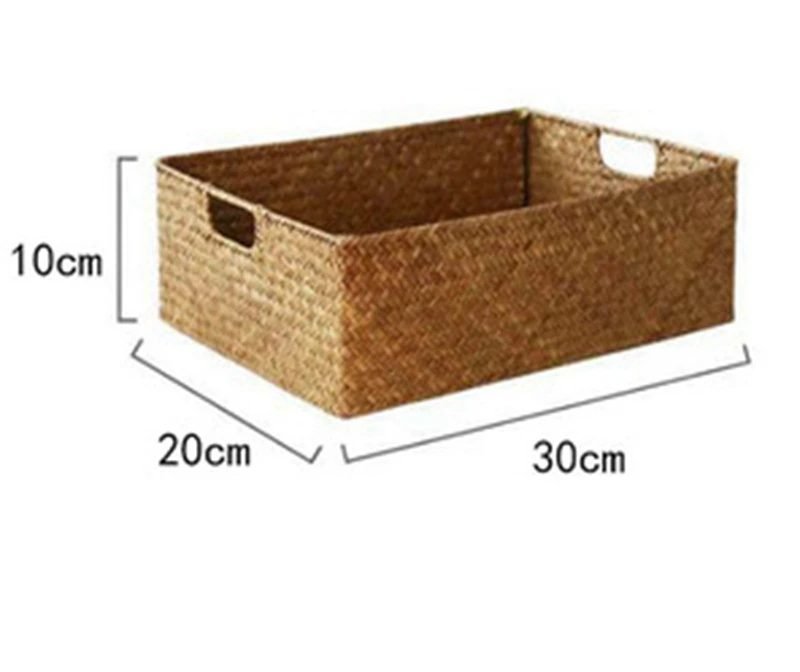
Quick answer: Repeat one basket rather than collecting several, keep the colour close to the wall so storage recedes, and label anything with a lid. For care, keep natural fibres dry and out of direct sun, and air anything that has been shut for a while before you refill it.
Thirty-odd years of hospital corridors taught me that things look calm when they match and chaotic when they nearly match. Gardens, wards and living rooms are all the same in that respect.
Repetition is the whole trick
One rule does most of the work: buy the same basket more than once.
Three identical baskets on a shelf read as a deliberate system. Three similar-but-different ones read as an accident, and oddly the near-miss is worse than an obvious mix. The eye notices the small difference and cannot settle.
Sets are usually cheaper per basket than singles too, so this is one of the rare cases where the better-looking option is also the cheaper one.
Let the colour recede
Storage should be quiet. It is holding the things you did not want to look at.
Pick a colour close to the wall or the shelving so the baskets disappear into the background - pale, grey, white or natural. Grey baskets suit almost any neutral scheme, and white keeps a small room feeling bright.
Strong colours have their place, but as one accent rather than a whole wall of storage. Kids' rooms are the honest exception, where colour is doing a different job.
Line the fronts up
A small physical habit that changes how a shelf looks more than anything you buy.
Push every basket to the same distance from the shelf edge - usually flush at the front. A row where some are pushed back and some stick out looks untidy even when everything is identical.
Same with handles: turn them all the same way. It takes ten seconds and it is the difference between a shelf and a display.
Label anything with a lid
Lids create a problem they do not advertise: you cannot see in.
Within a month you will not remember which box has the spare bedding and which has the Christmas things, and you will open three to find out. A simple label removes that entirely.
Anything open does not need labelling, because you can see. The lidded baskets guide covers deciding which to buy.
What to keep visible and what to hide
A useful split when deciding where things go.
Visible, open baskets for anything used daily or weekly - throws, remotes, post, the children's current toys. If getting it out is a chore, it ends up on the floor instead.
Lidded or high storage for seasonal and rarely used things - spare duvets, decorations, paperwork you must keep but never read.
The living room guide covers hiding everyday clutter without making it inaccessible.
Care: keep natural fibres dry
Seagrass, water hyacinth, rattan and similar are plant material. They cope with normal room humidity and they do not cope with being wet.
So: no soaking, no washing under a tap, and not in a bathroom that steams up daily unless you can air it properly. Dust with a dry brush, and wipe a mark with a barely damp cloth, then let it dry fully.
Direct sun is the other one. It fades and eventually embrittles natural fibre, so a basket on a sunny windowsill will not last as well as the same basket on a shelf.
The materials guide covers how each behaves.
Stopping the musty smell
The most common complaint with woven baskets, and it is nearly always the same cause: something went away slightly damp, and the basket was shut.
Air the basket somewhere dry with the lid off. Make sure whatever goes in is properly dry - laundry especially. And avoid storing natural fibre in a genuinely damp room, which no amount of airing will fix.
Fabric baskets are easier here, since many can be aired or spot-cleaned more freely - the fabric and woven range has those.
When to replace one
Fabric baskets go soft and stop standing up, which is the point they stop working. Woven ones fray at the rim where hands lift them. Wire ones are usually fine indefinitely - wire and metal baskets outlast everything else here.
Sizing a basket to its shelf
Styling falls apart when the basket does not fit, so it is worth a moment.
Measure the clear height, the internal width and the depth, then take a centimetre off each. A basket that fits exactly is one you cannot lift out when it is full, and a basket deeper than the shelf overhangs the front where everybody sees it.
Depth is the dimension people forget. Shelf depths vary from around 20cm on a bookcase to 30cm on a cube unit, and "storage basket" could be either.
Where handles help and where they do not
Above waist height a handle is close to essential, because otherwise you grip the rim and drag the basket out, which is what wears rims through.
Below waist height it matters far less, since you can see in and lift from above. If you do buy handled baskets for a shelf, choose ones cut into the side rather than protruding - a handle sticking out eats into the width you just measured.
Browse the full range, fabric and woven baskets and lidded baskets, with more in the complete guide.
The short version
- Buy the same basket more than once - a near-miss match looks worse than an obvious mix.
- Choose a colour close to the wall so storage recedes rather than announcing itself.
- Line the fronts up and turn the handles the same way; it takes seconds.
- Label anything with a lid, because within a month you will not remember what is inside.
- Natural fibre needs to stay dry and out of direct sun - most musty smells start damp.
Frequently asked questions
How do I make storage baskets look tidy?
Repeat the same basket rather than mixing. Three identical baskets read as a deliberate system while three similar-but-different ones read as an accident, and the near-miss actually looks worse than an obvious mix.
What colour storage baskets should I choose?
Something close to the wall or the shelving, so the storage recedes into the background - pale, grey, white or natural. Storage is holding what you did not want to look at, so it should be quiet rather than a feature.
How do I clean a woven storage basket?
Dust it with a dry brush and spot-clean marks with a barely damp cloth, then let it dry completely. Never soak it or wash it under a tap, since seagrass, rattan and similar are plant material and do not cope with being wet.
Why does my storage basket smell musty?
Almost always because something went in slightly damp and the basket was then closed. Air it somewhere dry with the lid off, make sure contents are fully dry before they go in, and avoid natural fibre in a genuinely damp room.
Should I label storage baskets?
Anything with a lid, yes. Within a month you will not remember which box holds the spare bedding, and you will open three to find out. Open baskets do not need it, because you can simply see what is inside.